
TL;DR: what did the EU find about Temu?
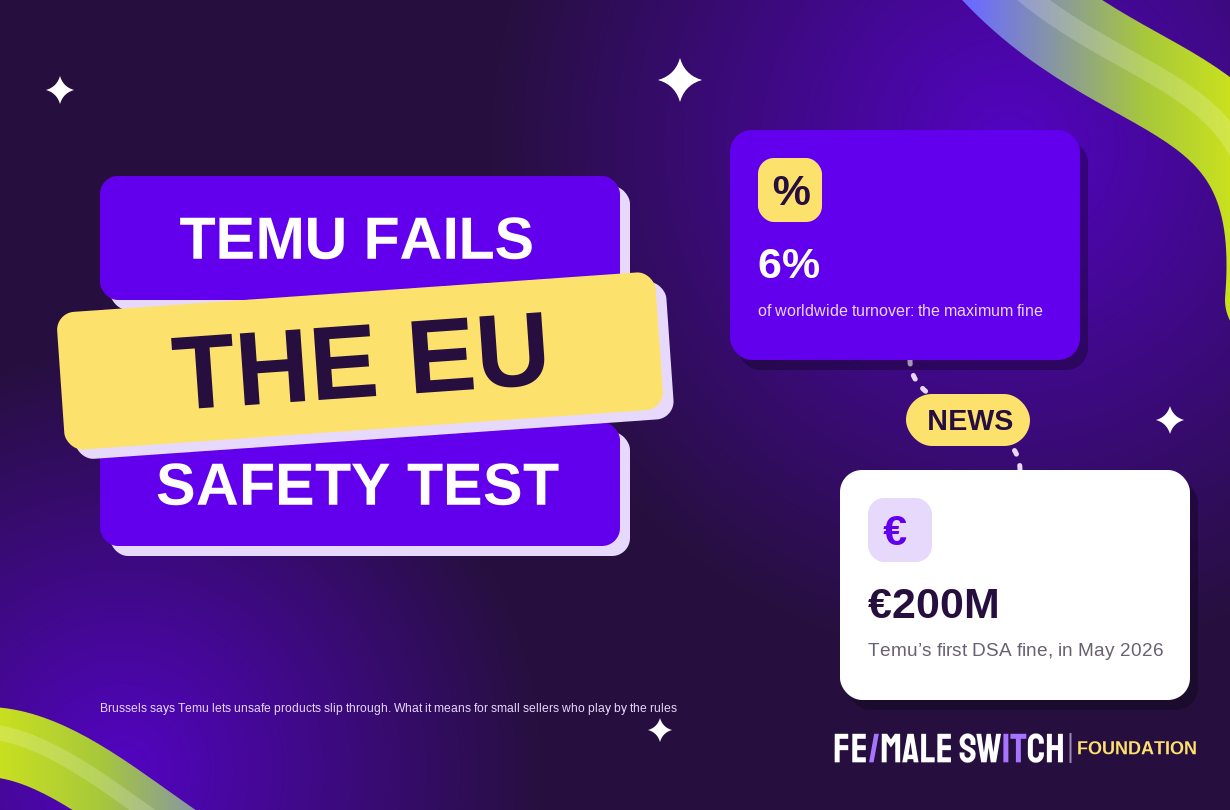
On 17 November 2026 the European Commission preliminarily found that Temu breaks the Digital Services Act (DSA) because it does too little to stop illegal and unsafe products being sold on its platform. Temu asks for test reports on only a very small share of products, doesn’t put toys, electronics and cosmetics first for physical checks, and punishes single stores instead of the traders behind them. If the finding is confirmed, the fine can reach 6% of Temu’s worldwide yearly turnover, after a €200 million fine in May. For small European sellers, the message is double: unfair competition from unsafe goods is now an enforcement priority, and every marketplace will tighten its checks on sellers, including you.
If you sell physical products online in Europe, you have probably lost a sale to a listing that looked like yours at a third of the price. You paid for safety tests, labels and an EU contact address. The other seller maybe didn’t.
This week, Brussels said out loud what many small sellers suspected. Here is what the Commission found at Temu, what happens next, and what it means for your own shop, whether you sell on Temu, Amazon, Etsy or your own website.
What happened
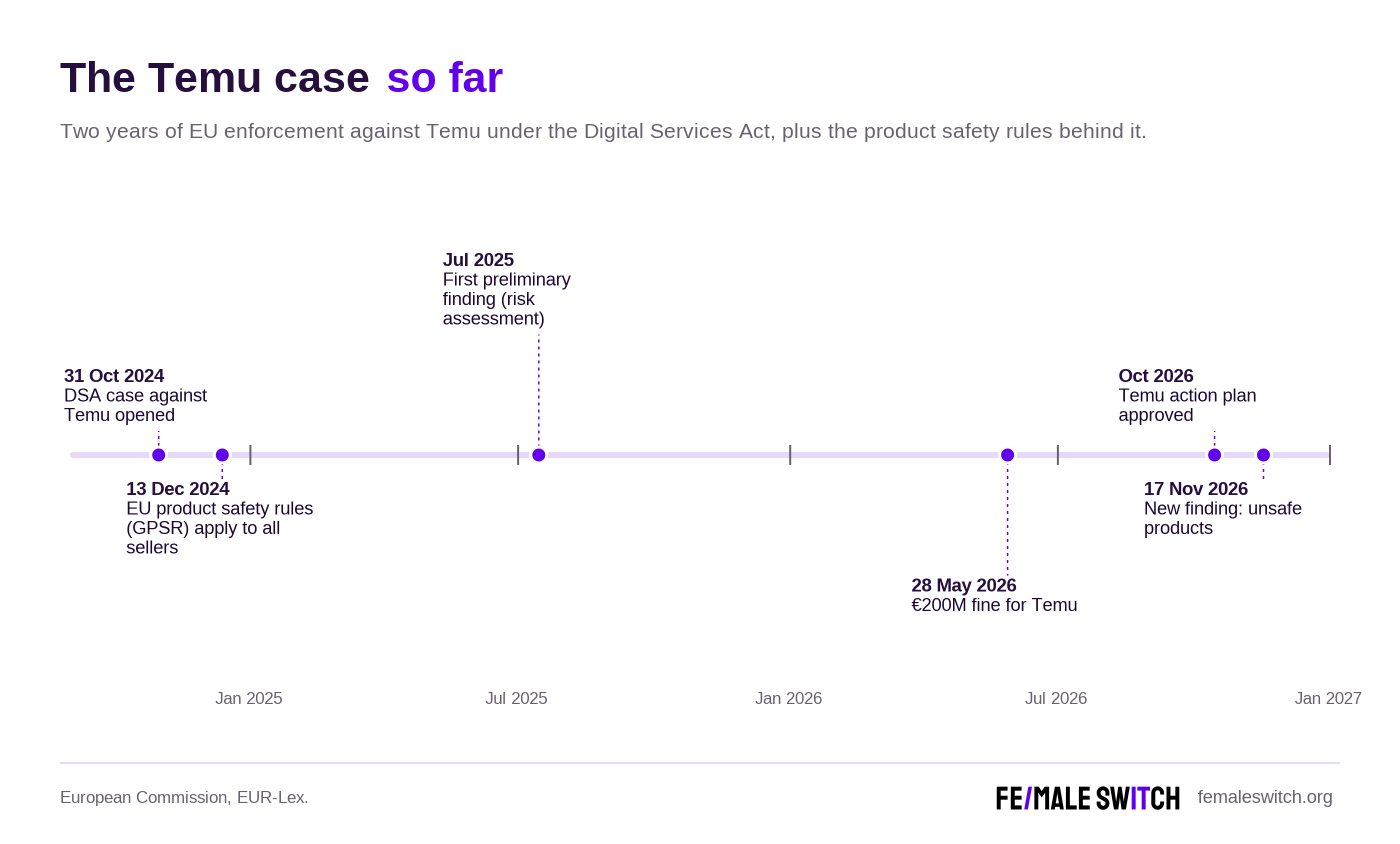
On Tuesday 17 November 2026, the European Commission preliminarily found Temu in breach of the Digital Services Act. The case is about Article 35, which obliges very large online platforms to take “reasonable, proportionate and effective” steps against the risks their service creates, in this case the risk of illegal products being offered to EU buyers.
The Commission named three weak spots:
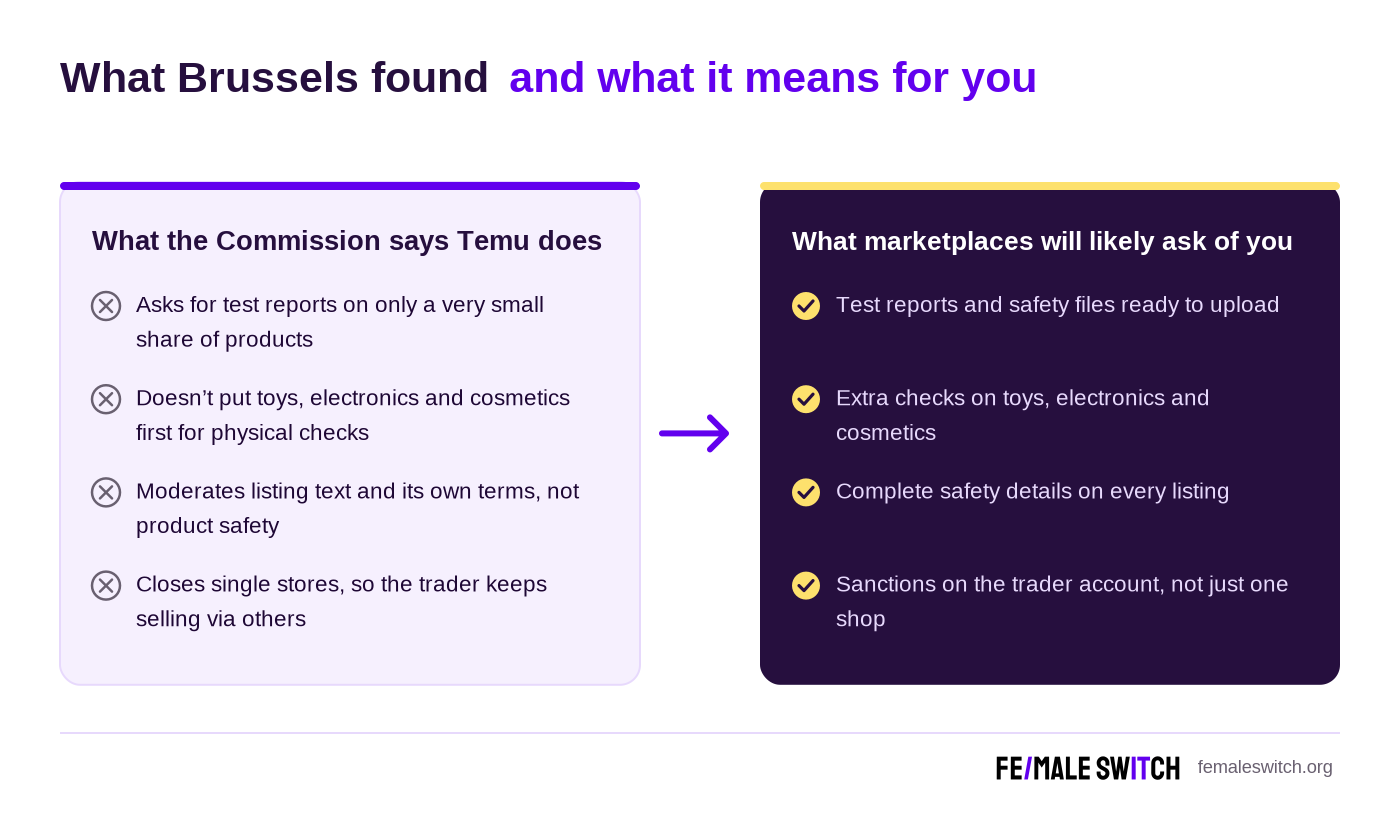
- Ineffective product checks. Temu asks sellers for test reports for “only a very small share of products”, and often doesn’t check them when they are required. It labels some categories as high risk, such as toys, electronics and cosmetics, but doesn’t put them first for physical checks. It also often didn’t follow up on its own spot checks, and didn’t increase inspections as the number of listings grew.
- Weak content moderation. Moderation looks mainly at the information attached to a listing and at Temu’s own terms, not at whether the product itself is safe. The number of human moderators has not grown in line with the number of listings.
- Sanctions that miss the trader. Temu punishes individual stores, not the trader behind them, although one trader can run several stores. A trader whose store is closed can keep selling through the others, and traders can commit many serious violations, including selling products that fail safety checks, before any store is suspended.
“Shopping online should not mean risking the purchase of illegal and unsafe products. Under the Digital Services Act, platforms are responsible for protecting users from the risk of illegal content and goods.” Henna Virkkunen, Executive Vice-President of the European Commission
Is this a fine? Not yet
Status: preliminary finding. The DSA itself is Adopted law and has applied to very large platforms since 2023, but this is not a final decision. Temu can now read the Commission’s investigation file and reply in writing, and the European Board for Digital Services, which brings together the national regulators, will be consulted.
If the Commission confirms its view, it can adopt a non-compliance decision with a fine of up to 6% of Temu’s total worldwide yearly turnover, and order the company to fix the problems. There is no deadline for that decision.
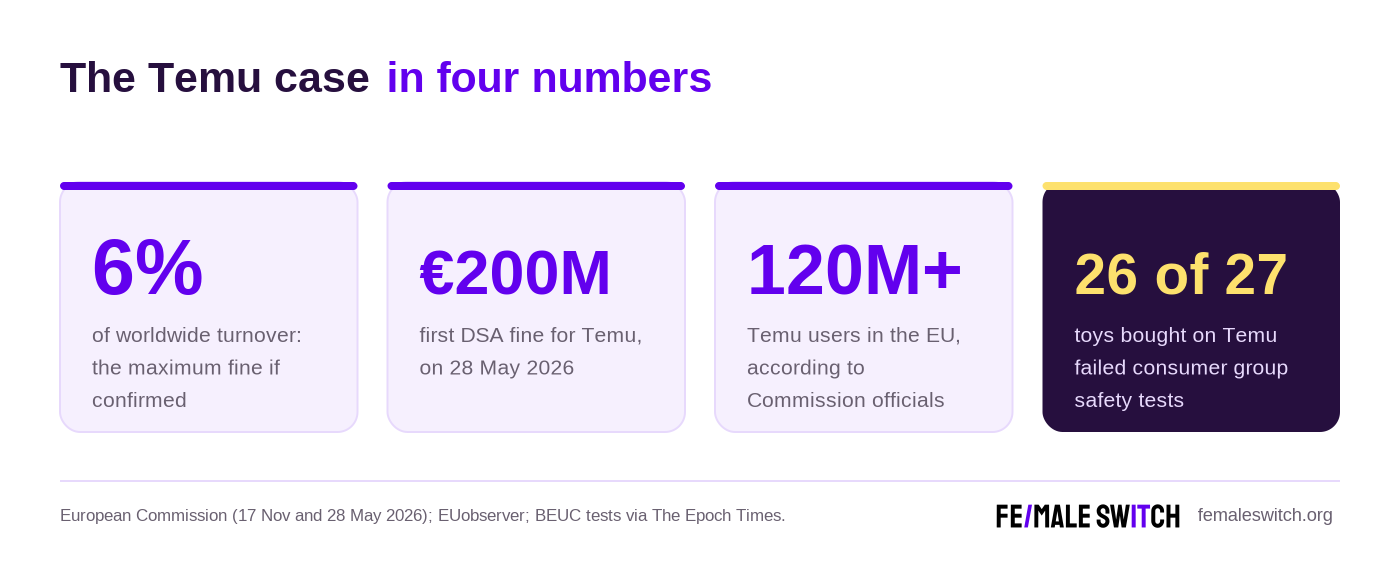
Temu has been here before. On 28 May 2026 the Commission fined Temu €200 million for a 2024 risk assessment that “seriously underestimated” how often EU buyers meet illegal items on the platform. In mystery shopping for that case, a very high share of the chargers bought failed basic safety tests, and many baby toys posed medium to high risks. The Commission approved Temu’s plan to fix that breach in October 2026. The case opened on 31 October 2024 and also covers addictive design, recommendation systems and data access for researchers.
Temu disputes the findings. A spokesperson told The Epoch Times that the company “will review and respond to the preliminary findings carefully and will continue to engage constructively with the commission”. Temu has more than 120 million users in the EU, according to Commission officials quoted by EUobserver.
Why small European sellers should care
Consumer groups have tested what Temu sells. Groups in Denmark, France and Germany, all members of the European consumer organisation BEUC, bought 81 products in October 2025, mostly from higher-risk categories. 53 failed to meet EU requirements, including 26 of 27 toys and 26 of 27 chargers.
Every one of those products competes with a European maker who pays for testing, labelling and an EU address. That is the unfair-competition side of this story, and it is why the case matters even if you never sell on Temu. BEUC said the same concerns apply to SHEIN, AliExpress and Amazon, so other marketplaces should expect the same questions.
The Temu finding is also one of several EU moves this year aimed at the flood of cheap parcels. Some are law, some are still proposals:
Sources: European Commission, EUR-Lex, Council of the EU. Status as of 20 November 2026.
We covered the money side earlier: the €2 handling fee on cheap parcels and the EU countries’ deal to end the €150 VAT threshold for imports. The Digital Fairness Act started as a leaked draft on dark patterns and is now an official proposal. Together with the Temu case, they close the price gap between ultra-cheap imports and European sellers a little more each year.
The rules that already apply to you
The Temu case is about a very large platform, but the product rules behind it apply to every seller, including a one-person shop. Two are worth knowing by article number.
GPSR, Article 19. Since 13 December 2024, anyone selling products online in the EU must show, clearly and visibly on the offer: the manufacturer’s name and postal and email address; for makers outside the EU, the name and address of a responsible person in the EU; information that identifies the product, including a picture, its type and any other identifier; and warnings or safety information in a language buyers understand. The full text of the General Product Safety Regulation also obliges marketplaces to act on product safety notices within three working days.
DSA, Article 30. Marketplaces must collect and check your details before you can sell to EU buyers: name, address, phone and email, a copy of your ID, payment account details, your trade register number where you have one, and a self-certification that you only offer products that comply with EU law. Under the Digital Services Act, you are liable for the accuracy of that information.
If marketplaces respond to the Temu finding by sanctioning traders rather than single shops, those Article 30 details are what will tie your stores together. Clean, correct trader data protects you; a mistake can freeze more than one shop.
What this means for you
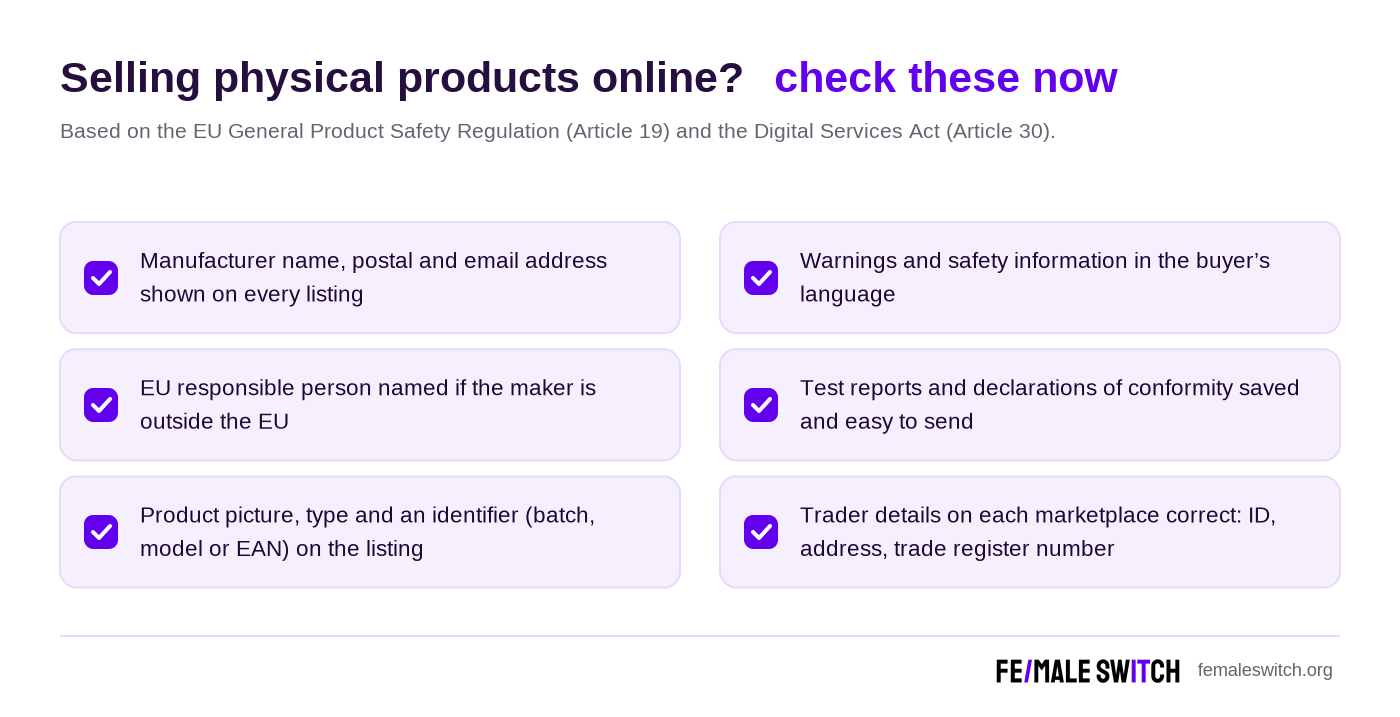
- Audit your listings this week. Go through your best sellers and check the four GPSR details on each one. Marketplaces that tighten moderation will look at exactly these fields. If you also sell second-hand or handmade goods, our guide to Etsy’s new rules for sellers shows how fast platform rules can change.
- Build a safety file per product. Keep test reports, declarations of conformity, supplier details and photos of labels in one folder per product. If you import from outside the EU, make sure an EU responsible person is named, and that it is not just an address on paper.
- Expect slower listings in risky categories. If you sell toys, electronics or cosmetics, plan for extra checks before a new product goes live, especially before Black Friday and Christmas. Our piece on packaging rules for small online sellers covers the other paperwork marketplaces ask for.
- Report unsafe copycats. Under the GPSR, marketplaces must process product safety notices within three working days. If a cheap copy of your product is clearly unsafe, report it with evidence; it is no longer a favour you ask but a duty the platform has.
- Turn compliance into a selling point. Say on your product page and in ads that your products are tested to EU standards, and be specific about what that means. Don’t invent urgency to compete on price: the UK already fined retailers for fake countdown timers, and the EU is moving the same way.
- Watch the other platform cases. The Commission also has open DSA cases on other platforms, such as its investigation into Booking.com. And if you sell on Amazon, read our summary of Amazon’s returnless refunds in Europe, because platform rule changes often land on sellers first.
Want to test a product idea before you pay for stock and safety tests?
The Fe/male Switch startup game takes you from idea to first paying customers in weekly quests, with an AI co-founder, so you can check demand, pricing and costs before you spend your savings. The free trial lasts 2 weeks.
👉 Start the game
FAQ: the EU’s Temu finding
Has the EU fined Temu again?
Not yet. On 17 November 2026 the European Commission issued a preliminary finding that Temu breaches the Digital Services Act by not doing enough against illegal and unsafe products. Temu can reply first. If the finding is confirmed, the fine can reach 6% of its worldwide yearly turnover.
What did the Commission find wrong with Temu?
Three things: Temu asks for test reports on only a very small share of products and often doesn’t check them; its moderation looks at listing text and its own terms rather than product safety; and it sanctions single stores rather than the traders behind them, so a trader can keep selling through other stores.
How much was Temu’s first EU fine?
€200 million, on 28 May 2026, for a 2024 risk assessment that seriously underestimated how often EU buyers meet illegal products on Temu. The Commission approved Temu’s plan to fix that breach in October 2026.
Does the Temu decision affect small sellers?
Indirectly, yes. The finding pushes all large marketplaces to check sellers and products more strictly, especially toys, electronics and cosmetics. The product rules behind it, such as the General Product Safety Regulation, already apply to every seller, including small shops.
What must an online product listing show under the GPSR?
Since 13 December 2024: the manufacturer’s name and postal and email address, an EU responsible person if the maker is outside the EU, information that identifies the product including a picture and type, and any warnings or safety information in a language buyers understand.
Are SHEIN, AliExpress and Amazon also under investigation?
The European consumer organisation BEUC says the same concerns apply to SHEIN, AliExpress and Amazon and has urged the Commission to finish its open investigations into Temu and SHEIN. The Commission’s 17 November finding concerns Temu only.
