
TL;DR: what changes for “buy now, pay later” in the EU on 20 November 2026?
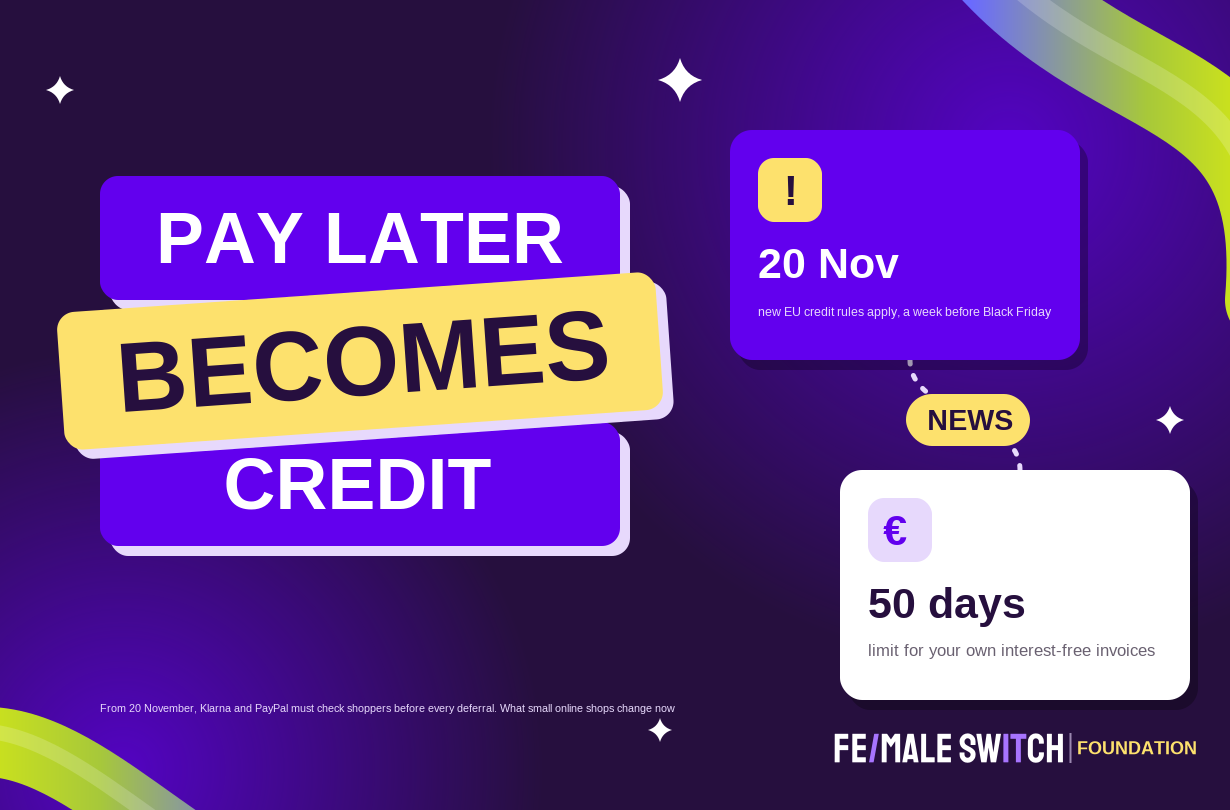
From Friday 20 November 2026, the EU’s new Consumer Credit Directive applies. Paying later through Klarna, PayPal or similar services becomes regulated consumer credit, even for small, short and interest-free deals, so the provider has to check whether the shopper can afford it before it says yes. Expect more declined pay-later attempts and an extra step at checkout, one week before Black Friday. Your own invoice stays outside the rules if it is free, nobody else finances or buys it, and it is due within 50 days of delivery (14 days for large online sellers). Check your checkout, your “€X a month” adverts and your fallback payment options this week.
For years, “pay in 30 days” has been the easiest yes at an online checkout. Shoppers liked it, and small shops liked the higher basket sizes. From next Friday, that yes comes with a credit check.
Here is what changes on 20 November, who has to do what, and the short list of things a small online shop should fix before Black Friday on 27 November.
What happened
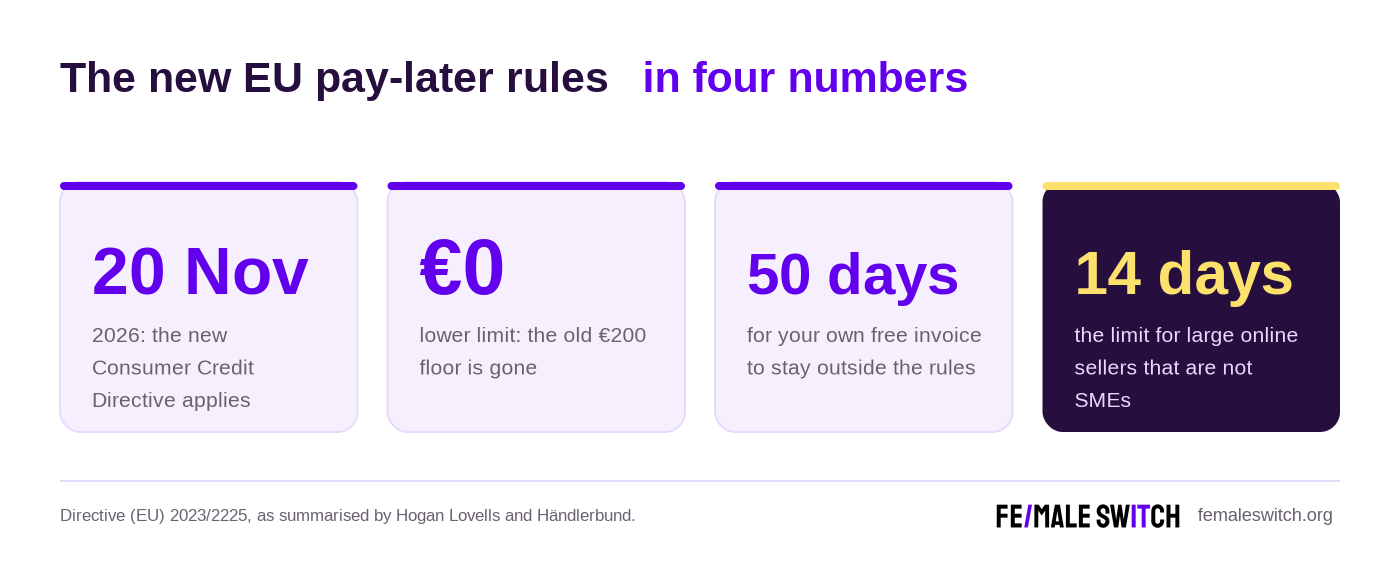
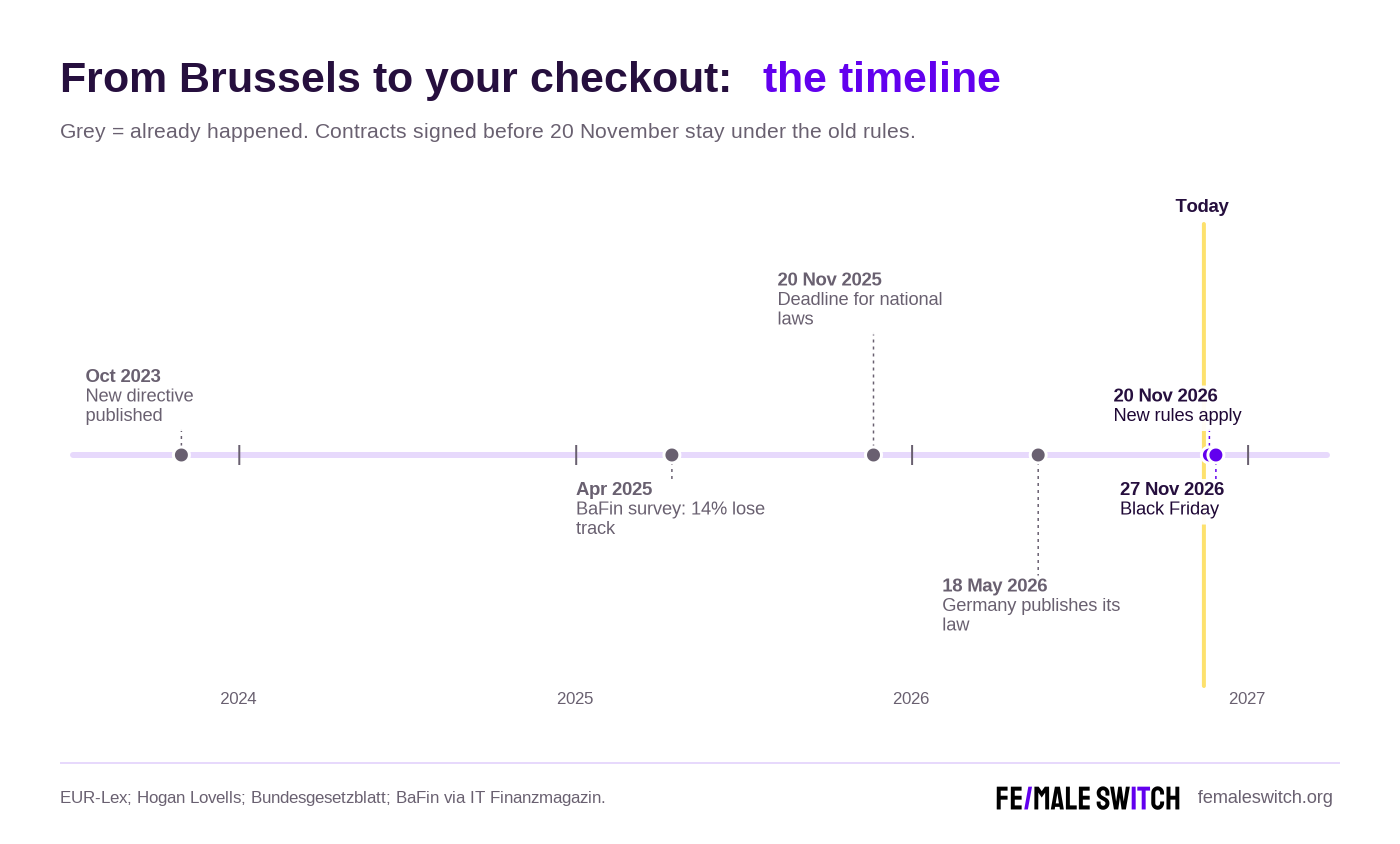
The EU adopted Directive (EU) 2023/2225 on consumer credit agreements in October 2023. Countries had until 20 November 2025 to write it into national law, and the new rules apply from 20 November 2026, when the old 2008 directive is repealed. Status: Adopted, and it applies from next Friday.
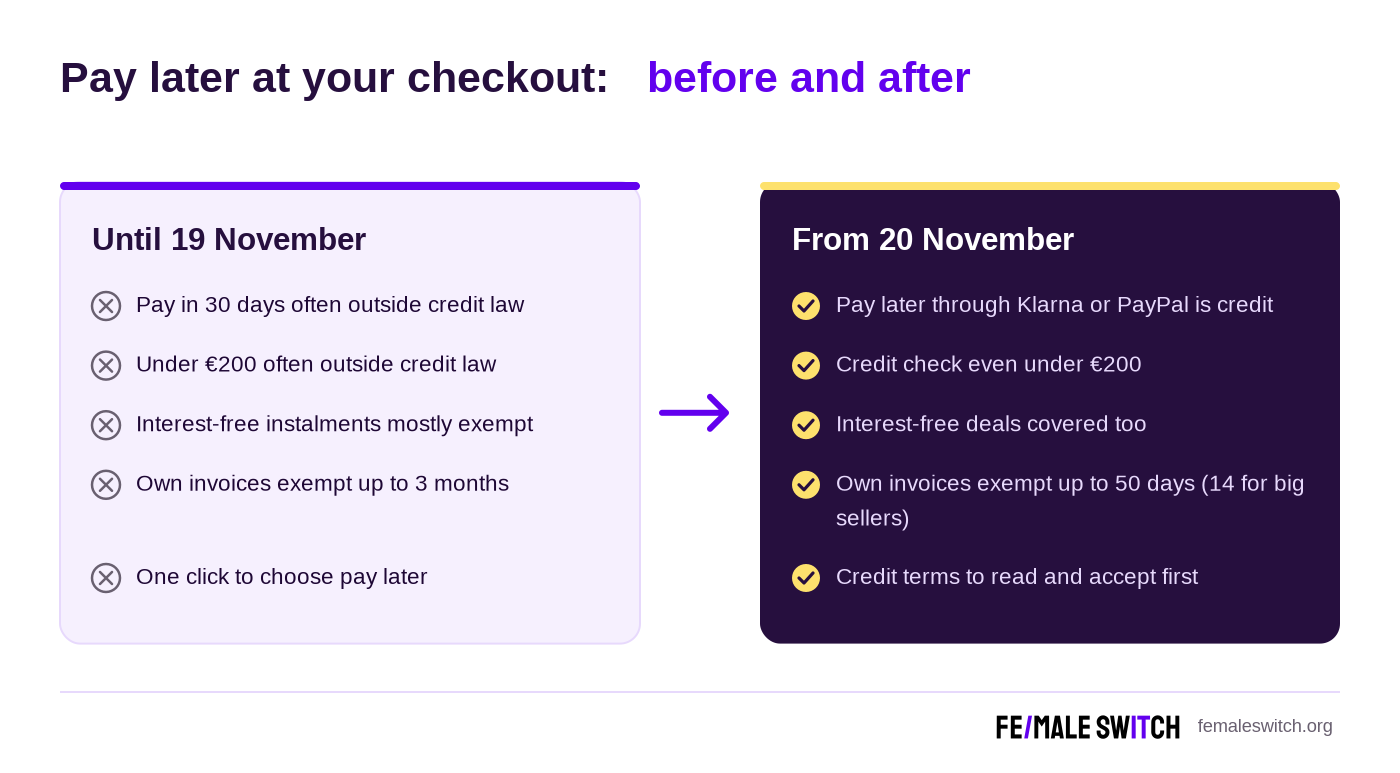
The big change is scope. According to a summary by the law firm Hogan Lovells, the old €200 minimum is removed, so small loans are no longer left out, while the upper limit is €100,000. Short-term and interest-free credit, which most pay-later products are, also comes in. That closes the gap that let “pay in 30 days” and “pay in 3” sit outside credit law in many countries.
So from 20 November, a provider such as Klarna or PayPal has to assess whether a shopper can repay before it grants the deferral. German coverage this week, such as Borncity’s report of 11 November, names PayPal’s “pay after 30 days”, Klarna, Stripe, Unzer and Ratepay among the services affected, and says health data and data from social networks may not be used for the check. If a computer turns the shopper down, they can ask for an explanation and a review by a human.
The rules apply to contracts signed from 20 November. Existing instalment plans carry on under the old law, and nothing bans pay later or 0% financing. A €120 purchase split into three payments of €40, the German site Netzwelt explains, can simply need a credit check first.
Why this lands on small shops a week before Black Friday
The lender runs the check, not you. Germany’s retail association Händlerbund explains that a merchant using a provider such as Klarna or PayPal does not automatically have to carry out the credit assessment itself. Stripe says the same: most obligations “will be the responsibility of the BNPL partner”.
But your checkout will feel it. Stripe’s note on Klarna says shoppers paying with Klarna must “review and accept Klarna’s credit terms before completing the payment”, through an extra redirect. If you built your own Stripe integration, “your integration must handle this redirect or the payment will fail.” If you use Stripe’s hosted Optimized Checkout Suite, no action is needed.
Subscriptions change too. Klarna will offer subscribers “a separate, reusable line of credit”, and if a subscriber says no, future payments switch to Pay in Full. If you sell boxes or memberships with Klarna, some customers will see new terms or a different payment on their next renewal.
Some providers are adding steps of their own. In Austria, according to the shopping site Baden liefert, Klarna only unlocks paying later after the shopper completes a budget check in its app, with monthly income and fixed costs. In Sweden, Borncity reports that more than a million Klarna users had already sent in income and housing details by the end of October.
What stays outside the rules: your own invoice
Many small shops and freelancers let customers pay their own invoice later. That can stay outside credit law, under four conditions set out by Hogan Lovells and Händlerbund.
Sources: Hogan Lovells; Händlerbund (6 October 2026); Austria’s VKrG 2026 as summarised by Baden liefert. National laws differ in detail.
The 50-day rule matters for freelancers and B2C service businesses too. After the EU dropped its plan for a 30-day cap on invoice payments, payment terms are still yours to set, but with consumers, giving more than 50 days for free can now make you a lender. Our guide on start-up costs on a bootstrap budget shows how to plan your cash so you don’t need long terms.
Adverts and checkout design: the rules that bite
Credit adverts must be fair and clear and include a warning that “Borrowing money costs money”, or words to that effect, Hogan Lovells writes. Austria spells it out: anyone advertising instalments or paying later must add “Achtung! Kreditaufnahme kostet Geld”, under section 8 of its new consumer credit act. A “Just €19.99 a month” banner on a product page is a credit advert, so either add the required information or remove it.
The directive also bans implied consent through default options such as “pre-ticked boxes”, and credit granted “without their prior request and explicit agreement”. So pay later can’t be pre-selected at checkout. The same idea runs through the EU’s proposed Digital Fairness Act and its list of banned checkout tricks.
Stripe’s advertising note lists Alma, Mondu, seQura, Scalapay and Klarna as the pay-later methods affected and asks merchants to “review all customer-facing content” against national law, because each country writes its own version.
Where each country stands
The directive sets the minimum; national laws fill in the details. Several countries are late.
Sources: Bundesgesetzblatt; Baden liefert; Borncity (11 November 2026). Check with your payment provider for your own country.
Germany’s version is the Act implementing Directive (EU) 2023/2225.
Why the EU did this
Regulators worry that pay later makes it easy to lose track. In a BaFin survey of almost 5,000 people in Germany from April 2025, 14% of pay-later users said they had lost track of their open bills, rising to 24% among under-30s. Twelve percent had pay-later debts above €500, and 29% of those paying in instalments said they used it because they didn’t have the money.
For founders, the lesson is about dependence. If a big share of your sales relies on shoppers who pay later, a stricter check can cut conversion overnight. Our guide to pricing psychology for your product covers other ways to make a price feel affordable, such as smaller bundles or a starter version.
What this means for you
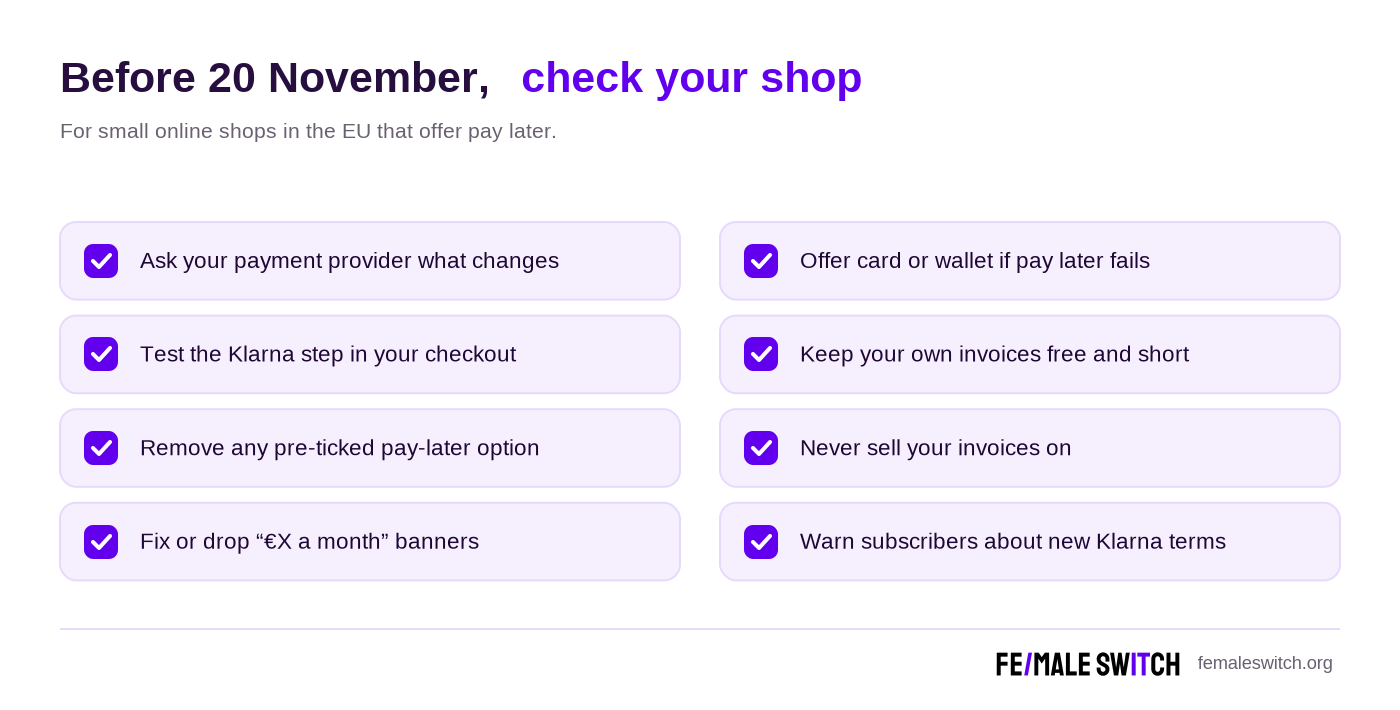
- Ask your payment provider today. Klarna, PayPal and Stripe are all changing their flows, so whichever provider you use, ask what changes in your checkout and whether you need to update a plugin or integration before 20 November.
- Test the checkout like a customer. Buy something with pay later in a test or live order. If you run your own Stripe integration, make sure the new Klarna redirect works, or those payments will fail.
- Make the fallback easy. More shoppers will be declined. Card, wallet and bank transfer should be one click away, without losing the basket.
- Clean up your adverts. Remove “€X a month” banners you can’t back with the required credit information, and never pre-select pay later. Black Friday rules on prices still apply too; our Black Friday rules checklist for small sellers covers prior prices and promotion messages.
- Keep your own invoices simple. Free, no factoring, due within 50 days of delivery (14 if you are a large online seller). Write the terms on the invoice. Our guide for the solo founder going it alone in Europe covers invoicing basics.
- Tell your subscribers. If you take subscriptions through Klarna, send a short note that their payment provider may ask them to accept new terms, so a declined renewal doesn’t look like your fault.
Selling on Amazon instead of your own shop? The marketplace handles payments, but its returns rules for the season changed too; see our piece on Amazon’s keep-the-item refunds in Europe.
Want to practise pricing and payments before real money is on the line?
The Fe/male Switch startup game takes you from idea to first paying customers in weekly quests, with an AI co-founder, so you can test your offer, your pricing and your checkout without risking your savings. The free trial lasts 2 weeks.
👉 Start the game
FAQ: the new EU buy now, pay later rules
When do the new EU buy now, pay later rules start?
On 20 November 2026, when Directive (EU) 2023/2225 on consumer credit agreements applies and the old 2008 directive is repealed. Contracts signed before that date stay under the old rules.
Will Klarna and PayPal check my customers’ credit?
Yes. From 20 November, pay later through these providers counts as consumer credit, even for small, short or interest-free deals, so the provider must assess whether the shopper can repay before granting it.
Do I have to run credit checks as a small shop?
Usually not. When you use a provider such as Klarna or PayPal, the provider is the lender and runs the check, according to Händlerbund and Stripe. You still need to adapt your checkout and your adverts.
Can I still let customers pay my own invoice later?
Yes, if the deferral is free, no third party finances or buys the claim, and payment is due within 50 days of delivery. Large online sellers that are not SMEs are limited to 14 days.
Are pay-later adverts still allowed?
Yes, but they count as credit adverts. They must be clear, include the required information and a warning that borrowing money costs money, and pay later can’t be pre-selected at checkout.
Does this apply in every EU country on the same day?
The directive applies from 20 November 2026, but each country writes its own law. Germany and Austria have adopted theirs, while the Netherlands and Czechia are late, according to reports this week.
