
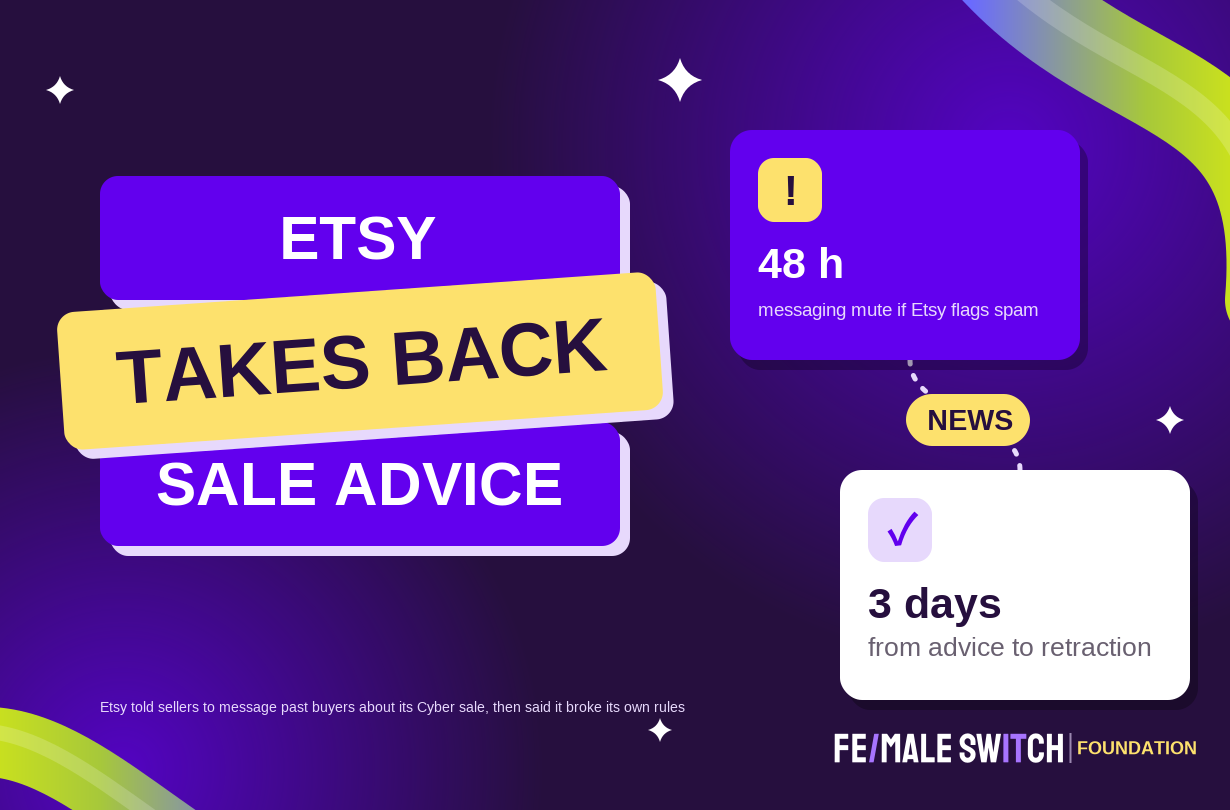
TL;DR: can I message past Etsy buyers about my Black Friday sale?
No. On 6 November 2026, Etsy told sellers to use Etsy Messages to tell past buyers about its Cyber Specials sale. Three days later, on 9 November, it told them to ignore that advice, because its own rules ban “unsolicited advertising or promotions” in Messages. Etsy did not say whether sellers who already sent such messages are safe from its spam filters, which can mute an account’s messages for 48 hours. Promote your sale with shop announcements, social posts and your own email list instead. In the EU and the UK, marketing emails need consent, with a narrow exception for your own customers who were given an opt-out.
If you sell on Etsy, you may have got two messages from the platform this week that contradict each other. The first told you to send a warm note to past buyers about your holiday discounts. The second said that note would break Etsy’s rules.
Here is what Etsy said, what happens if you already sent those messages, and how to promote a Black Friday sale in Europe without breaking Etsy’s rules or marketing law.
What happened
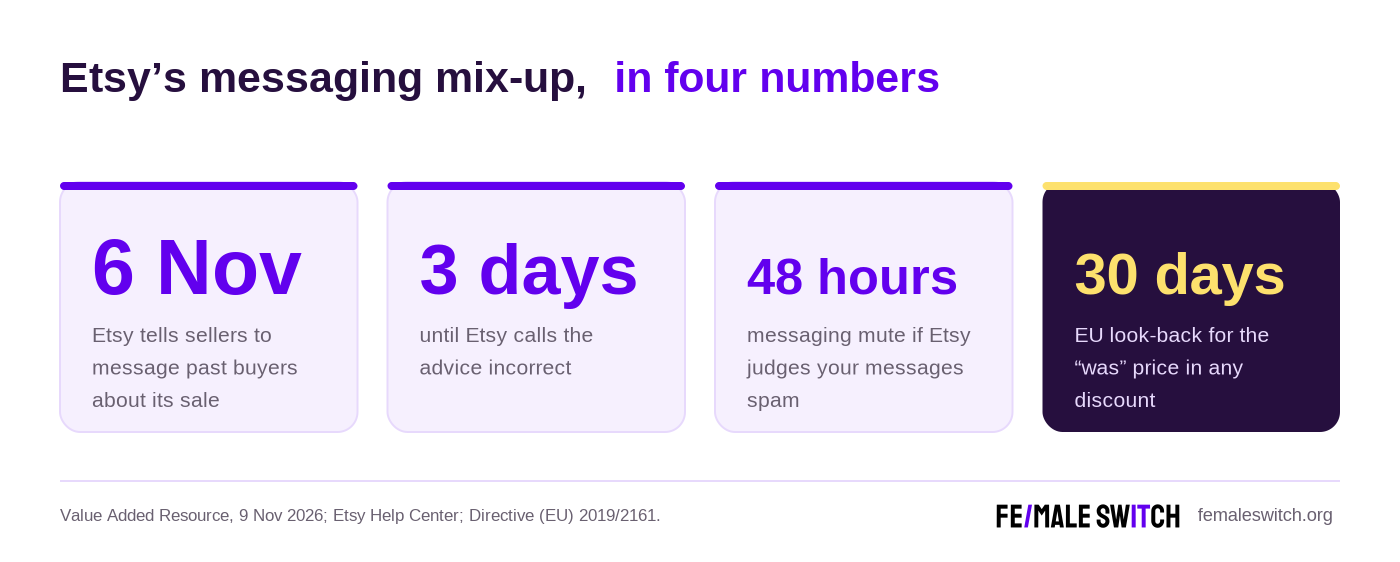
On Friday 6 November, Etsy sent sellers a message about its Cyber Specials holiday sale, inviting shops that took part last year to sign up again. According to Value Added Resource, which first reported the story, the message told sellers to “head to your Convos in Shop Manager to send a message to past buyers” and to “send out a warm note through Convos” about their discounts.
On Monday 9 November, Etsy sent a correction. “In that message, we encouraged you to contact past buyers through Etsy Messages to share details about your upcoming sale,” it wrote. “This advice was incorrect and doesn’t align with Etsy’s policies,” which “prohibit sending unsolicited advertising or promotions through Messages.” Etsy apologised, saying: “We know you rely on us for clear, accurate guidance when running your shop, and we apologize that we got this wrong.” It pointed sellers to shop announcements and social media instead.
The ecommerce newsletter Shopifreaks also covered the retraction on 10 November. Neither report found an answer to the question many sellers asked: what happens to shops that followed the first message?
Why a sale message can cost you your inbox
Etsy’s Seller Policy lists “unsolicited advertising or promotions, requests for donations, or spam” among the things sellers may not send through Messages. As Value Added Resource notes, the rule has no exception for people who have bought from you before. Use Messages for questions about orders and custom requests.
The penalty can hit fast. Etsy’s Help Center says: “If Etsy determines that a certain amount of the messages you’ve sent are spam, your messages will be muted for 48 hours.” While muted, you can’t message other Etsy users, and “Etsy support agents are unable to reverse this temporary mute.” In the busiest sales week of the year, two days without messages means unanswered questions about orders, gifts and delivery dates.
Etsy’s correction did not say whether it will make exceptions for sellers who acted on its advice before 9 November. If you sent sale messages to past buyers, stop now, don’t send follow-ups, and keep your answers to buyers short and about their orders. If your messages get muted, save the correction message from Etsy in case you need to explain what happened.
This isn’t the first rule change Etsy sellers have had to digest this autumn: in October it also banned AI-generated patterns and required real photos on most listings.
What EU and UK law says about marketing to past customers
Etsy’s rule is stricter than the law in one way: it bans promotions in Messages even to your own past buyers. But the law matters as soon as you market outside Etsy, by email or on your own web shop.
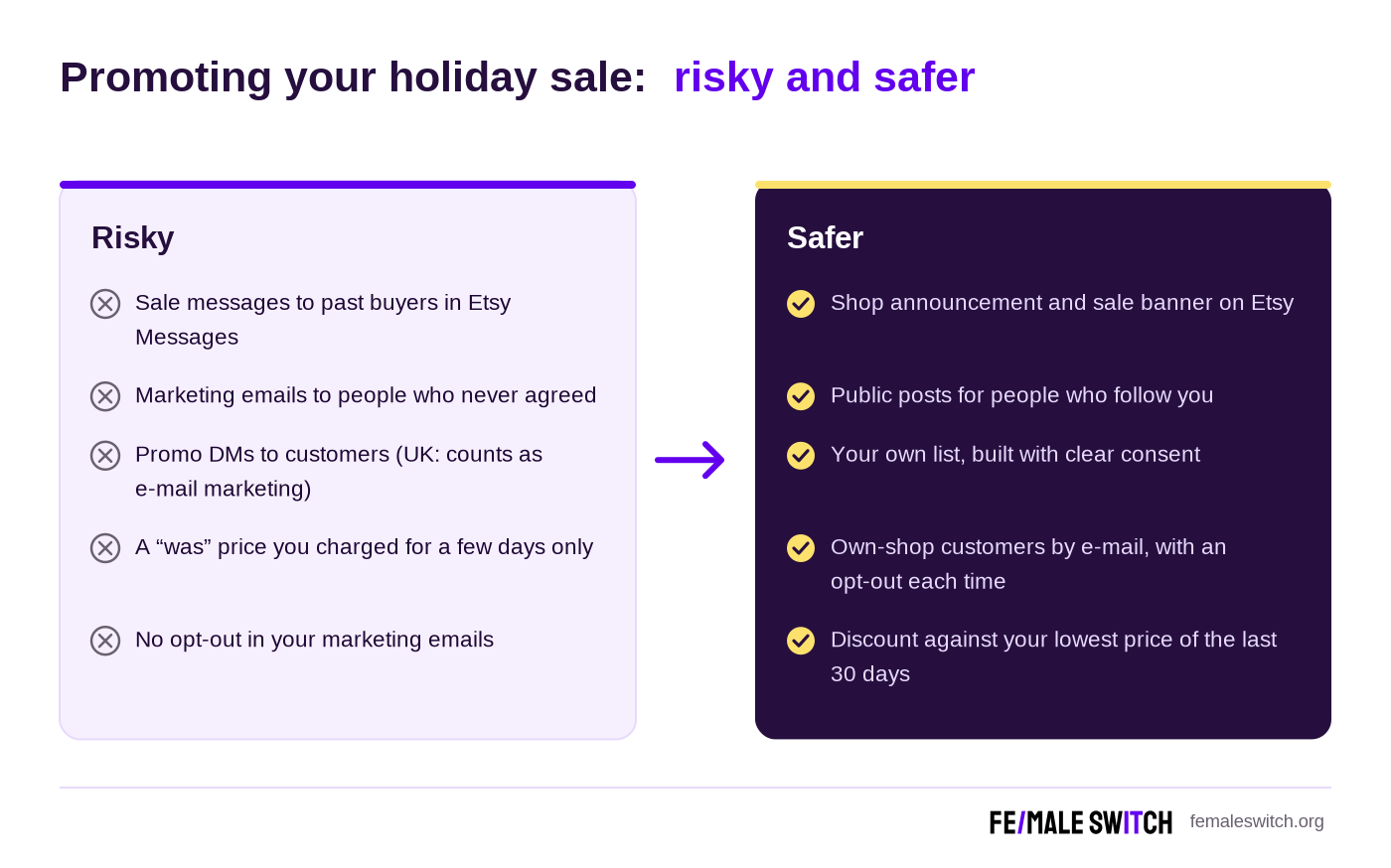
In the EU, the rule comes from Article 13 of the ePrivacy Directive. Sending marketing emails to private people needs their “prior consent”. There is one exception, often called the soft opt-in: if you got a customer’s email address “in the context of the sale of a product or a service”, you may email them about your own similar products, as long as you gave them a free and easy way to object when you collected the address and in every message you send. Each country writes this into its own law, so details differ.
In the UK, the Information Commissioner’s Office says the same rules apply to “direct messages via social media or any similar message that is stored electronically”, not only to email. Its soft opt-in has the same conditions: an existing customer who bought, or negotiated to buy, a similar product, and a simple way to opt out every time. The ICO says this guidance is under review after the Data (Use and Access) Act.
Two things follow for Etsy sellers. First, whatever the law allows, Etsy’s own rule decides what you can send through its inbox. Second, the safest list is one people joined on purpose. Our guide to getting your first email subscribers shows how to build one from scratch, and our GDPR guide for startups covers how to store those addresses.
Sources: Etsy, via Value Added Resource; Etsy Help Center; ePrivacy Directive, Article 13; UK Information Commissioner’s Office.
The other rules for your Black Friday sale
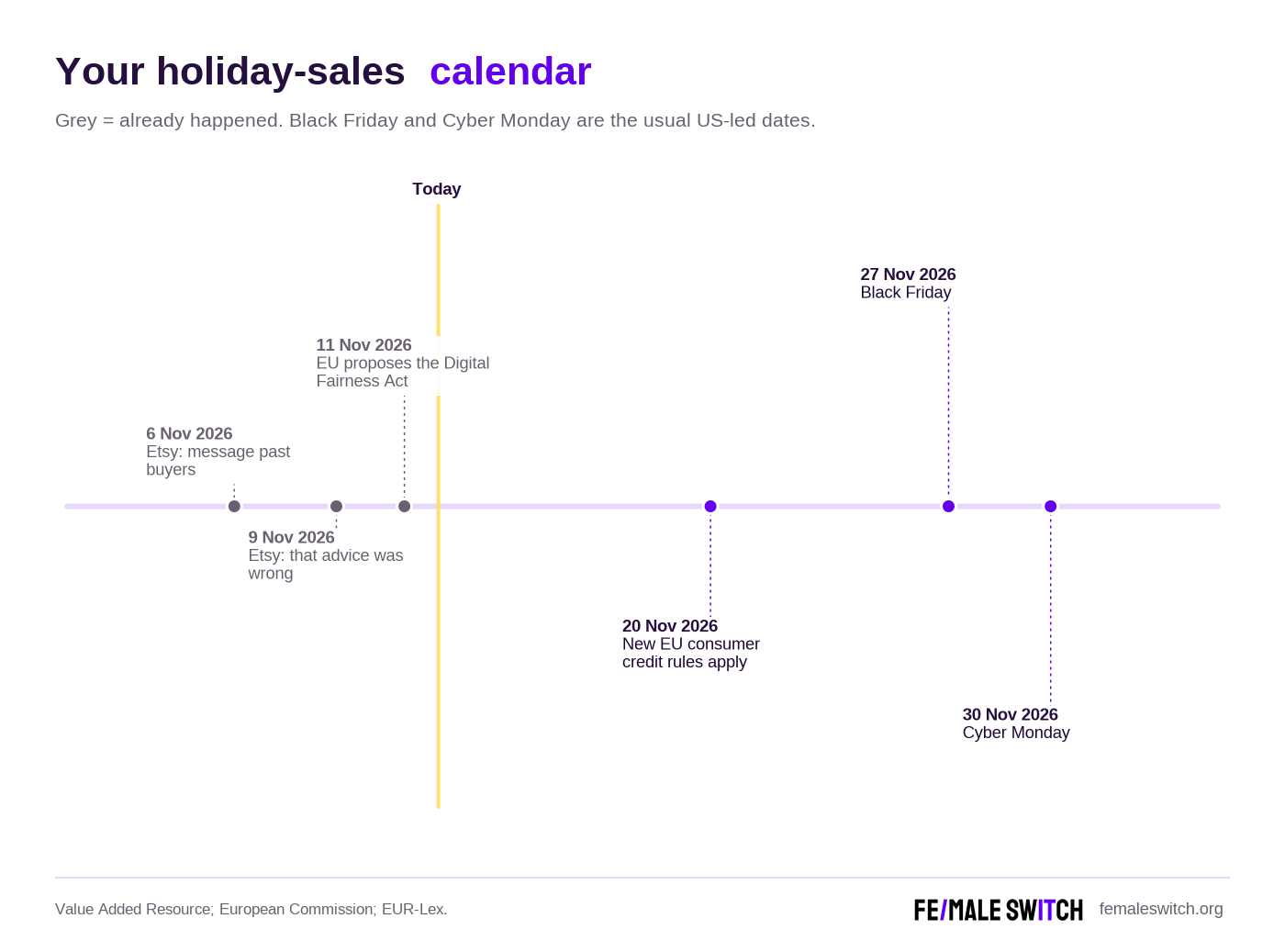
Messages aren’t the only thing to check before Black Friday on 27 November. Three EU rules apply to how you price and sell during the sale, and a fourth is on the way.
The “was” price. Since 28 May 2022, any announced price cut in the EU must show the prior price, defined in Directive (EU) 2019/2161 as “the lowest price applied by the trader during a period of time not shorter than 30 days prior to the application of the price reduction”. If you raise a price in early November to show a bigger discount on Black Friday, the “was” price is still your lowest price of the last 30 days. Countries may set shorter periods for new products and fresh goods.
Pay later at checkout. From 20 November 2026, the new Consumer Credit Directive applies, and buy-now-pay-later offered by a third party counts as consumer credit, with checks by the lender. If you let customers pay your own invoice later, it stays outside the rules if there is no third party, no interest or other charges, and payment is due within 50 days of delivery. For large online sellers that are not SMEs, the limit is 14 days. Our news piece explains what the new pay-later rules change at your checkout, from Klarna’s extra step to “€X a month” banners.
Fake urgency. Countdown timers that reset and false “only 2 left” claims are already risky under today’s consumer law, as the UK’s fines for fake countdown timers showed. On 11 November the European Commission proposed the Digital Fairness Act, which would ban false scarcity claims in every case.
Sources: EUR-Lex; European Commission; Etsy, via Value Added Resource.
What this means for you
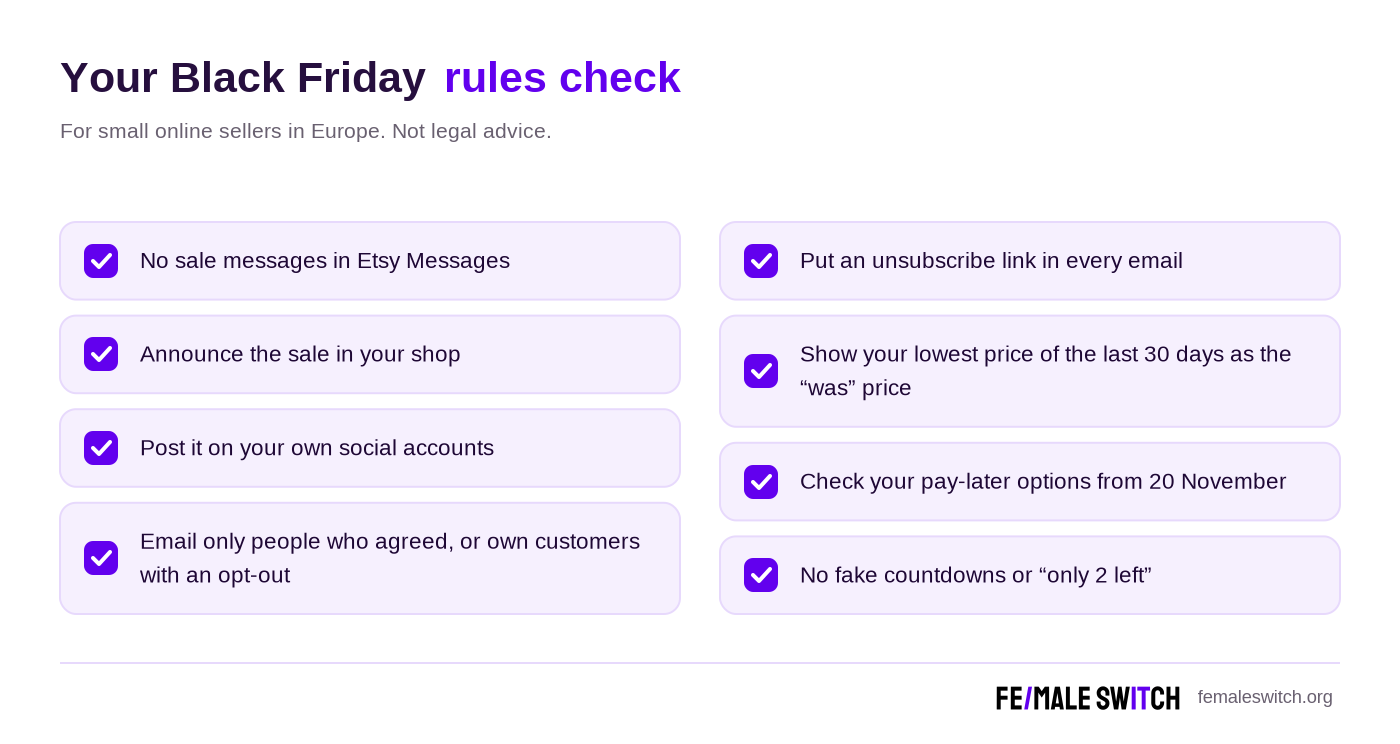
- Stop any sale messages in Etsy Messages. Even to your best repeat buyers. Answer questions about orders as usual, but keep promotions out of the inbox.
- Use the channels Etsy approves. Update your shop announcement, add the sale to your listings and banner, and post it on your own social accounts. Our guide to limited-time offers on social media has ideas that don’t rely on fake urgency.
- Build your own list for next year. Add a sign-up link to your social bios, packaging insert or own website. People who join on purpose open your emails, and you don’t depend on a platform’s rules to reach them.
- Check every discount against your last 30 days. Write down your lowest price for each product since late October before you set a Black Friday “was” price. Our article on product pricing psychology explains which discount framings still work.
- Look at your payment options before 20 November. If your checkout offers a third-party pay-later option, check what your provider says about the new rules.
- Plan for repeat customers, not one big blast. A buyer who had a good experience comes back without a sales message. Our guide to customer retention strategies covers thank-you notes, reviews and service that keep them coming back.
Want to practise selling before real customers pay?
The Fe/male Switch startup game takes you from idea to first paying customers in weekly quests, with an AI co-founder, so you can test offers, prices and marketing channels without risking your savings. The free trial lasts 2 weeks.
👉 Start the game
FAQ: Etsy messages and Black Friday marketing
Can I message past Etsy buyers about a sale?
No. Etsy’s Seller Policy bans unsolicited advertising or promotions in Messages, with no exception for past buyers. On 9 November 2026, Etsy said its earlier advice to message past buyers about its Cyber Specials sale “was incorrect and doesn’t align with Etsy’s policies.”
What happens if Etsy decides my messages are spam?
According to Etsy’s Help Center, if it determines that a certain amount of your messages are spam, your messages are muted for 48 hours, and support agents can’t reverse the mute.
I followed Etsy’s advice before 9 November. Am I protected?
Etsy hasn’t said. Its correction told sellers to disregard the earlier message but did not say whether it would make exceptions for sellers who acted on it. Stop sending sale messages, and keep Etsy’s correction in case you need to explain.
How can I promote my Etsy sale instead?
Etsy suggests shop announcements and social media. You can also add the sale to your listings and banner and email people who signed up to your own list.
Can I email my own customers about a sale without their consent?
In the EU and the UK, only under the soft opt-in: you got their email address when they bought from you, you are promoting your own similar products, and you gave them an easy way to opt out when you collected the address and in every email.
Which price can I show as the “was” price on Black Friday?
In the EU, the lowest price you charged for that product in at least the 30 days before the discount, under Article 6a of Directive 98/6/EC as amended in 2019.
