
TL;DR: EU grants for startups are real money, and most first-year founders aim at the wrong ones. The EIC Accelerator offers up to €2.5 million, but its October 2025 cut-off drew 923 full applications and the EIC announced 61 winners after the January interviews. A bootstrapped team of one to three people has better odds with smaller schemes: cascade calls paying €5,000 to €50,000, national programmes co-financed by EU funds, Erasmus for Young Entrepreneurs at €600 to €1,200 a month, and Women TechEU at €75,000 once you have a prototype. Put your situation into the free EU grant reality check below and get a shortlist, the hours each application costs you and a year-one plan.
EU grants for startups come up in every second conversation I have with women in the Fe/male Switch community, and the question is always "Should I apply to the EIC?" My answer, as a bootstrapping founder who has filled in more EU forms than I care to count, is a calendar and a calculator. A grant is only cheap money if the hours you spend on it are cheaper.
The top results for eu startup funding are lists written by consultancies for deep tech teams with a grant writer on the payroll. This guide is for one to three people with little or no revenue, writing applications at night. I checked every amount, deadline and rule below on official EU and national pages on 5 November 2026.
How does the EU grant reality check work?
Tell the tool where your company is, your stage, whether your product is deep tech, whether the company is women-led, your team size, your free hours a week and what one of your hours is worth. It returns three to six realistic options for year one with the amount and form of money, our estimate of the hours to apply priced in euros and the next official cut-off, then a skip for now list and a year-one plan you can copy.
A founder who bills clients at €60 an hour pays twice as much for the same application as one who values her evening at €30, so put in your own number.
What counts as an EU grant, and what is equity or an allowance?
Several offers sold as "european grants for startups" on page one are something else. Sort every offer into one of these boxes first.
- Grant: money you keep and never repay.
- Lump sum: a grant paid as a fixed amount when you reach agreed results, with no timesheets. Women TechEU pays its €75,000 this way, according to its FAQ.
- Equity: an investor buys shares. The EIC Accelerator's investment part, €1 million to €10 million, is equity or quasi-equity such as convertible loans.
- Prize: money for winning a contest.
- Allowance: a monthly contribution to living and travel costs, the Erasmus for Young Entrepreneurs model.
- Co-financing: the share you pay yourself. The EIC Pre-Accelerator funds 70% of costs, so the company brings 30%.
- Cut-off: the date and hour when a call collects proposals for evaluation.
- De minimis aid: small state aid a company can receive without EU approval. The European Commission caps it at €300,000 per company over three years, and since 1 January 2026 Member States record it in a central register. National grants paid from EU funds count toward it.
Which EU grants can a bootstrapped startup realistically win in year one?
"Year-one realism" is my judgement for a team of one to three with little or no revenue. Hours are our estimate.
TRL (technology readiness level) is the EU's nine-step scale of technical progress. The Horizon Europe General Annexes define TRL 4 as "technology validated in a lab", TRL 6 as "technology demonstrated in a relevant environment" and TRL 8 as "system complete and qualified". An idea on paper sits at TRL 1 to 3.
How does cascade funding work for a small team?
Cascade funding, officially FSTP (financial support to third parties), means the Commission funds a project and that project runs its own open calls to pass money to startups, SMEs and sometimes individuals. You never join the consortium (the group of organisations that signs the EU grant), and the forms are short.
Three rules in the Horizon Europe Work Programme 2026-2027 General Annexes make these calls friendly for bootstrappers:
- every cascade call is published on the EU Funding & Tenders Portal;
- every call stays open for at least 2 months;
- projects publish who won, for how much and from which country, so you can read past winners first.
On the portal, open Calls for Proposals and pick "Calls for funding in cascade (issued by funded projects)". BAYFOR, the Bavarian EU funding advisory, says cascade grants need "significantly less administrative effort" than standard Horizon Europe projects.
A real example: NLnet's Restack fund, paid through a Horizon Europe grant, gives €5,000 to €50,000 for a first grant to open, free-software internet projects. The form caps the project summary at 1,000 characters, and the next deadline is 3 January 2027 at 12:00 CET. A solo founder can finish that in a long weekend.
A cascade grant is only as safe as the project paying it. Read what happened to startups when EIT Manufacturing went into liquidation before you budget money that has not arrived.
Which national programmes are paid from EU funds?
The biggest pot of eu funding for startups rarely says "EU" in its name. The ERDF (European Regional Development Fund) pays for regional development, support for small businesses included, and national and regional authorities pick the projects, according to the European Commission. Its sister fund, the ESF Plus (European Social Fund Plus), co-finances founder programmes. You apply to your own agency, in your own language.
- Slovenia: the Slovene Enterprise Fund planned its P2 2026 call for new businesses at €2.16 million, up to €72,000 per company. In 2025 the same call drew nearly €1.4 million of its €2.16 million from the ERDF, according to the Slovenian government.
- Germany, exist Women: up to ten months of support for women from universities and research organisations, a €2,000 material budget and, for some, up to three months of stipend at €1,000 to €3,000 a month. Co-financed by the ESF Plus; you apply through your university.
- Germany, exist Gründungsstipendium: 12 months of stipend (€2,500 a month for graduates), up to €10,000 in material costs for a solo founder, for teams of up to three. Also ESF Plus.
Ask your regional development agency one question: "Which of your startup grants are co-financed by the ERDF or the ESF Plus, and when is the next call?" Our guide to grants for women entrepreneurs in Europe lists women-only schemes, and our overview of entrepreneurship training programmes for women covers funded courses.
Is Women TechEU realistic for a first-year founder?
Women TechEU is the best-known eu startup grant for women, and it suits a narrow group. According to its FAQ you need:
- a company with legal personality, registered for six months to five years at the eligibility cut-off (sole proprietors are excluded);
- a woman founder in a top role (CEO, CTO, CSO or equivalent), with women holding at least 25% of the shares;
- a deep tech product at TRL 4 to TRL 6;
- under €1 million of equity raised.
The money is a €75,000 lump sum plus a six-month business programme. The press release for this round speaks of €12 million for 160 startups, 40% reserved for widening areas, and says applications "pushed the success rate below 4%".
The eligibility check runs every Tuesday at 17:00 Brussels time until 15 June 2027. Only applicants confirmed eligible get the full proposal link, with deadlines on 14 January, 1 April and 8 July 2027. The full proposal asks for CVs, an investor pitch deck and a three-minute video in which the woman founder appears; our pitch deck examples from women-led startups help with the deck.
My verdict: your company must be six months old at the eligibility check. Registered in October 2026, you pass the check from April 2027 and aim for 8 July 2027. At idea stage, skip it this year.
What is Erasmus for Young Entrepreneurs, exactly?
It is an exchange, and the money is an allowance. You work for 1 to 6 months with an experienced entrepreneur in another participating country, and the programme pays a monthly contribution to living and travel costs. The amount depends on the host country. From the table for exchanges starting from 1 June 2024, still the current one:
You qualify if you are over 18, live in a participating country and plan a business on a viable business plan or have under three years of entrepreneurial experience. There is no upper age limit, you can take part only once, and applying is free: register online, pick a local contact point, send a CV, a motivation letter and a business plan. The catch, stated by the programme: you cover costs beyond the allowance.
Which EIT programmes take idea-stage founders?
The EIT (European Institute of Innovation and Technology) runs EIT Jumpstarter for people before they have a company. Its 2026 terms excluded ideas whose startup was registered before 1 January 2026, so a company founded this year was fine.
- Money: prizes of €10,000, €5,000 and €3,000 for the top teams in each thematic cohort.
- Who: individuals or teams, up to two co-founders supported, with at least one citizen of an EIT RIS country, among them Spain, Italy, Portugal, Greece, Poland, Czechia, the Baltic states and Ukraine.
- Effort: one online form, then about 15 hours of online bootcamp and, for up to 82 teams, about 40 hours of training.
The 2026 call closed on 17 May 2026 and 2027 dates are not published yet.
Who is the EIC Accelerator really for?
The EIC Accelerator suits a deep tech company at TRL 6 to 8 with a team able to run a 24-month project and a plan to raise investment. It offers a lump sum grant below €2.5 million and €1 million to €10 million in equity. The EIC publishes four steps:
- Short proposal: a 12-page form, a deck of up to ten slides and a video of up to three minutes, any time.
- Full proposal after a GO: a 20-page form plus deck, financials, letters of intent and a freedom-to-operate analysis.
- Jury interview for the top-ranked proposals.
- Grant signature and due diligence for the equity.
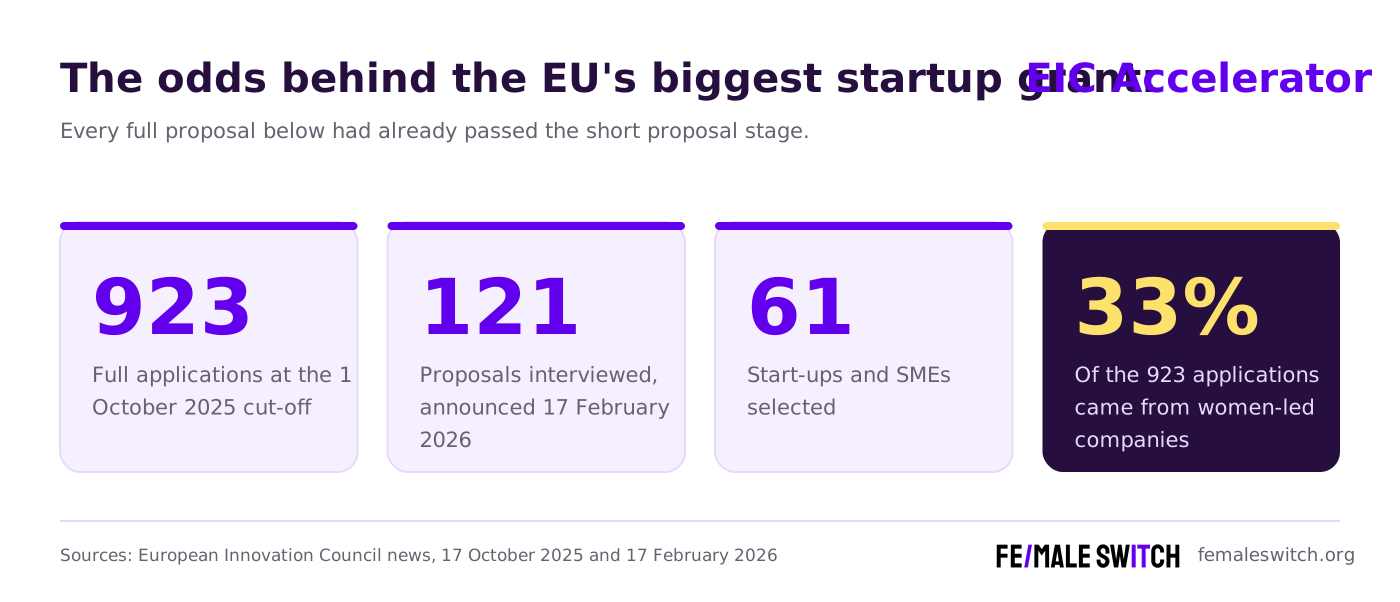
The 1 October 2025 cut-off received 923 full applications, 33% from women-led companies. After January interviews, the EIC announced on 17 February 2026 that 61 companies were selected out of 121 interviewed. By my arithmetic, that is about 7 in every 100 full proposals, each of which had already passed the short proposal.
The EIC has not published 2027 cut-offs; an online info day on 2027 funding runs on 19 November 2026. For year one, skip it and spend the 250 hours on customers. Deep tech founders in widening countries (among them Poland, Portugal, Greece, Czechia and the Baltic states) can plan for the EIC Pre-Accelerator: no 2026 call, the 2027 call opens 5 May 2027 and closes 18 November 2027. For what investors expect before that stage, read our guide on realistic pre-seed funding expectations.
How can a small startup join a Horizon Europe consortium?
Most Horizon Europe collaborative calls need, by default, three independent organisations from three different countries, at least one in an EU Member State, according to the General Annexes. Universities need small companies to test results with real users and look for them months before a deadline.
As a partner you write your own work package, budget and letter, and the coordinator carries the proposal. Leading one as a two-person startup costs hundreds of hours, so say yes to partner invitations and no to leading. Ask your nearest university's tech transfer office which teams are writing proposals in your field, and meet them through our list of communities for female entrepreneurs.
How many hours does each EU grant application take?
No official page publishes hours, so here is our estimate, priced at an example value of €30 an hour.
How we estimated the hours: we counted each scheme's published page limits, steps and interview stages and allowed about 2 to 3 hours per page of form, 4 to 6 per pitch deck and 4 to 8 per short video, plus portal registration and annexes. These are Fe/male Switch estimates for a first-time applicant, never official figures.
A €50,000 cascade grant at 20 hours earns more per evening than a €2.5 million grant at 250 hours with odds of about 7 in 100. Our time management systems for solo entrepreneurs shows how to protect those hours from client work.
Which EU grants should a bootstrapper skip in year one?
- EIC Accelerator: TRL 6 to 8, a 24-month project, 250 hours. Come back with traction.
- EU Prize for Women Innovators: up to €100,000 and closing on 1 December 2026, but the company must be registered before 1 January 2025.
- Leading a Horizon Europe consortium: join as a partner.
- Women TechEU at idea stage: TRL 4 is the floor.
- EIC Pre-Accelerator outside widening countries: ineligible.
- Any scheme you have to bend your product to fit. It pulls you away from paying customers.
What does a year-one EU grant calendar look like?
Official dates published as of 5 November 2026:
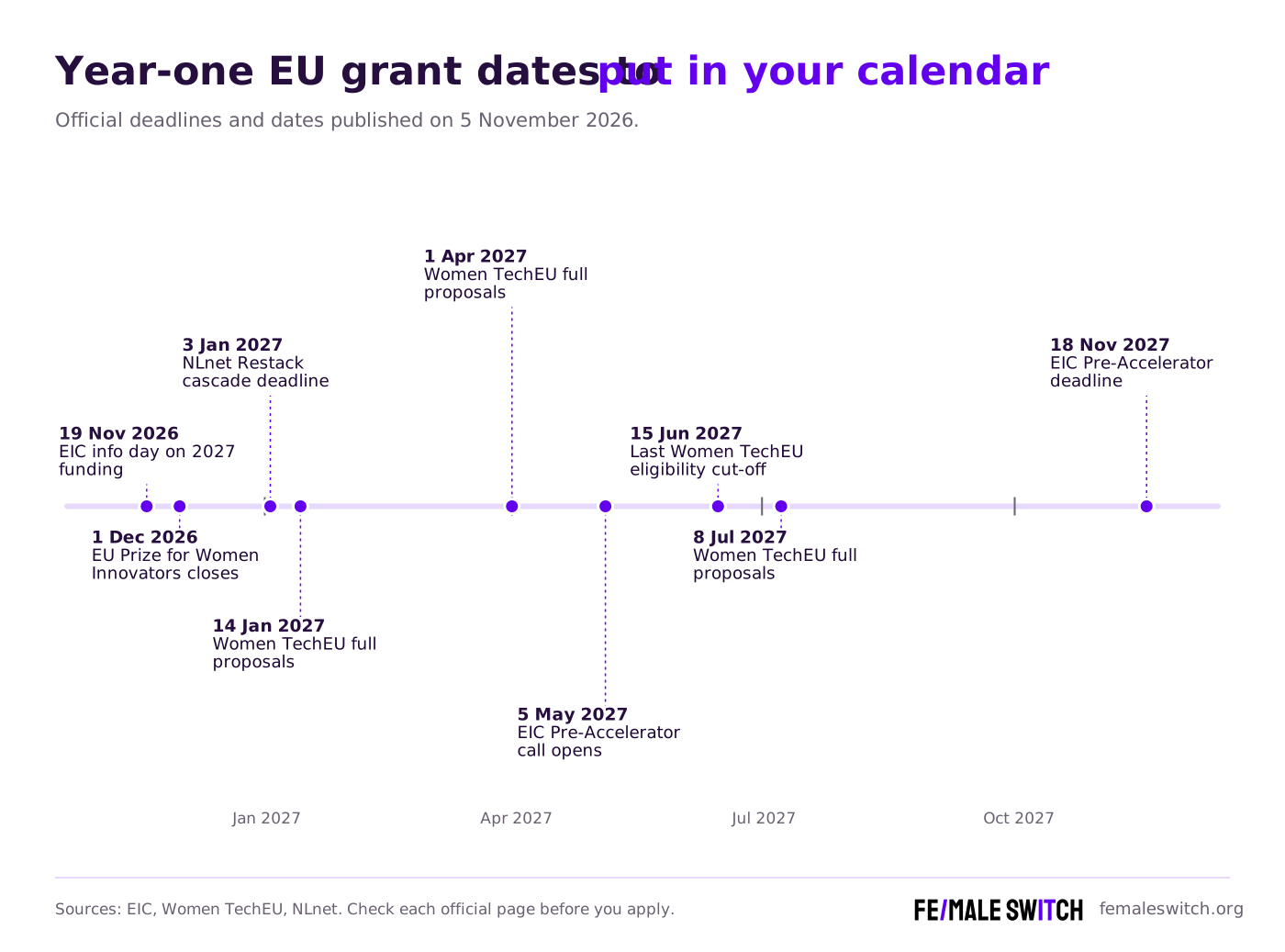
Copy this year-one EU grant calendar:
- November 2026: register on the EU Funding & Tenders Portal, save a search for cascade calls, ask your agency about ERDF and ESF Plus calls.
- December 2026: write your first cascade application (NLnet Restack closes 3 January 2027 for open-source internet projects).
- January 2027: apply to Erasmus for Young Entrepreneurs and look for a host.
- February to March 2027: national scheme, when your agency opens its call.
- March to June 2027: women-led deep tech at TRL 4+: pass the Women TechEU eligibility check, then write for 8 July 2027.
- Spring 2027: watch for EIT Jumpstarter 2027.
- May to November 2027: EIC Pre-Accelerator (closes 18 November 2027) in widening countries.
Every application starts with the same paragraph:
Copy this one-paragraph project summary:
[Company] is a [number]-person startup in [city, country] building [product] for [customer]. Today [customer] loses [time, money or risk] because [problem]. Our [product] does [what it does] and has reached [stage: prototype tested with X users / X paying customers / TRL X]. With [amount] from [scheme] we will [two or three concrete results] within [months], and success means [one number you will measure]. The team: [names, one relevant fact each].
Our guide to using ChatGPT for grant drafts turns it into a first draft without pasting confidential data into an AI tool.
How do you prepare your first EU grant application?
- Run the reality check and pick two options, three at most, for the next six months.
- Read the call text and the applicant guide twice and test yourself against every eligibility rule before you write.
- Read past winners. Cascade projects must publish them.
- Write the summary paragraph, then expand it in the official template.
- Show proof: customer conversations, pre-orders, test results. Our guide on validating a business idea without spending money gets you that proof.
- Submit two days early, as Women TechEU advises in its own call text.
Practise the founder side before you write the grant. In the Fe/male Switch startup game you build a startup step by step: validate the idea, price it, plan a budget and pitch it, which is most of what an EU application asks for. While you wait for results, read how to bootstrap as a female founder and self-funding your startup while working full-time.
What should a bootstrapping founder do about EU grants this month?
Treat EU money as a bonus on top of a business that works. Women TechEU promises results within eight weeks of a deadline, and contracts and payments come after that. Customers pay faster, which is why our plan for starting a startup without funding starts with sales.
This month: run the reality check, register on the portal, save a cascade search and email your agency. When you need money faster than a grant pays, compare alternative funding sources for women-led businesses and crowdfunding platforms for women-led projects, and plan cash with our start-up costs on a bootstrap budget guide. With women-founded startups' share of European VC down to 11%, non-dilutive money is worth winning well. Running it alone? Our solopreneur guide for women in Europe covers the legal form these schemes ask about.
FAQ: EU grants for startups
Can a startup get EU funding in its first year?
Yes, through smaller schemes: cascade calls (NLnet's Restack fund pays €5,000 to €50,000), national programmes co-financed by the ERDF or ESF Plus, Erasmus for Young Entrepreneurs and EIT Jumpstarter.
Can I apply for EU grants as a sole trader?
For some. Erasmus for Young Entrepreneurs, EIT Jumpstarter and some cascade calls accept individuals. Women TechEU excludes sole proprietors.
How much is the EIC Accelerator grant?
A lump sum below €2.5 million for up to 24 months, plus €1 million to €10 million of equity or quasi-equity, according to the EIC.
What is cascade funding in EU grants?
Money an EU-funded project passes to startups and SMEs through its own open calls, also called FSTP. Each call stays open for at least two months on the EU Funding & Tenders Portal.
How much does Erasmus for Young Entrepreneurs pay?
€600 to €1,200 a month depending on the host country, for 1 to 6 months: €950 in the Netherlands, €900 in Germany, €1,200 in Denmark.
Who can apply for Women TechEU?
A company registered for six months to five years in the EU or an associated country, with a woman founder in a top role, women holding at least 25% of shares and a deep tech product at TRL 4 to 6.
Do EU grants have to be paid back?
Grants, lump sums, prizes and allowances do not. The EIC Accelerator's equity part is an investment for shares, and many national "startup funds" are loans.
How long does an EU grant application take?
Our estimate: about 10 hours for EIT Jumpstarter, 20 for a cascade call, 50 for Women TechEU and 250 for the EIC Accelerator.
